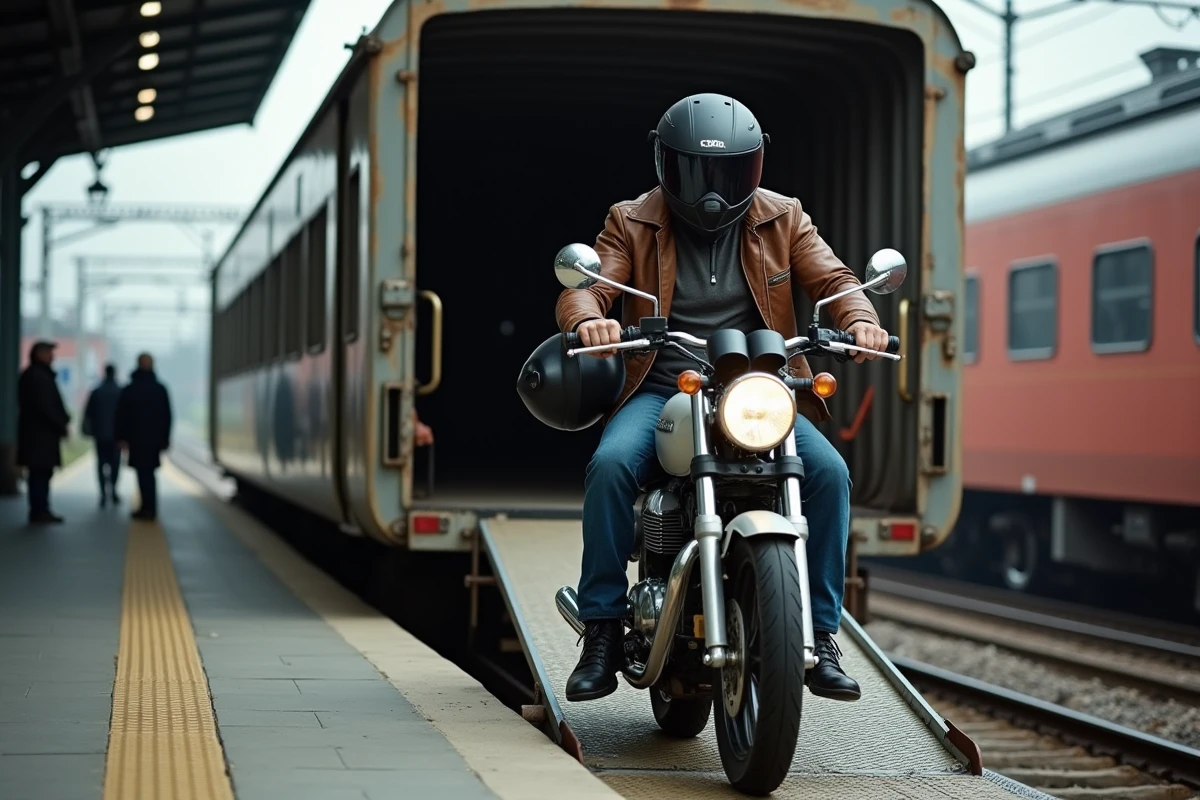
You are preparing a road trip in Italy or Austria and would like to avoid the hundreds of kilometers of highway before hitting the beautiful roads. The idea of loading your motorcycle onto a train seems logical. The problem is that in France, this service has not existed since the end of 2019. So, what options are left to combine train and two-wheels in Europe?
End of the SNCF motorcycle train: what has changed since 2019
The SNCF motorcycle train service allowed you to ship your two-wheeler on a car-carrying wagon, overnight, between several French stations. The principle was simple: you dropped off the motorcycle the day before, you took a train on your side, and everyone met at the destination.
This service definitively ceased at the end of 2019. Since then, SNCF no longer provides any transport for motorcycles or scooters on its lines. No announcement of a resumption has been made.
For those looking to put their motorcycle on a train with SNCF, the direct answer is therefore no, it is no longer possible in France. However, SNCF has formed a partnership with Hiflow, a vehicle transport service by truck, accessible via SNCF Connect. Hiflow transports your motorcycle by road, not by rail.
Hiflow via SNCF Connect: road transport, not rail
Hiflow is presented as an SNCF partner for vehicle transport throughout France. The name may be confusing, but it is important to understand the difference: Hiflow transports your motorcycle by truck, on a flatbed or in a closed van.
In practice, you book on SNCF Connect or on the Hiflow website. A transporter comes to pick up the motorcycle from your home or at a collection point, then delivers it to the destination. You, on your side, take a TGV or a regular train.
This is not motorcycle train in the historical sense. The vehicle does not travel in the same convoy as you. Delivery times depend on distance and the availability of transporters. Prices vary according to the route, type of motorcycle, and period.
Why does this distinction matter? Because if your goal is to reduce your carbon footprint by avoiding a road trip, having the motorcycle transported by truck negates part of the benefit. It is a comfort solution, not an ecological alternative equivalent to rail.
Trains with motorcycle-carrying wagons in Europe: DB and ÖBB
If you want your motorcycle to actually travel on a train, you need to look at foreign operators. The DB (Germany) and ÖBB (Austria) companies still offer trains with car-carrying wagons, particularly on certain night routes between Germany and Italy.
The operation resembles the former French motorcycle train:
- You drop off the motorcycle at the departure station, on the dedicated wagon, following the securing instructions from the staff
- You travel on the same train, in a sleeper or in a seat depending on the route
- You pick up the motorcycle at the arrival station, usually the next morning
The most well-known routes connect cities in southern Germany (Munich, for example) to destinations in Northern Italy or Austria. For a French motorcyclist, this means first reaching the German or Austrian departure station, either by riding or taking an initial train.
Book early or give up
Spaces for motorcycles on these trains are very limited. Feedback from motorcyclists on specialized forums and on Reddit (discussion threads dated 2024 and 2025) converge on one point: during peak season, motorcycle quotas are regularly full. Booking several months in advance becomes the norm to secure a spot.
The DB and ÖBB websites allow you to check availability online, but navigation is not always intuitive for a French-speaking user. Some routes only appear on the German version of the site.
Rail interoperability: what could change
A major hurdle for French motorcyclists is the difficulty in organizing a combined trip. Buying an SNCF ticket to Munich, then a DB ticket with a motorcycle wagon to Italy, requires juggling between multiple platforms and languages.
Two recent legislative developments deserve attention:
- The European Commission has proposed requiring historical rail operators to sell tickets for their competitors on their own platforms
- In France, an amendment voted in the Senate on April 16, 2026, as part of the framework law on transport, plans to require SNCF to market tickets from its rail competitors on SNCF Connect
If this provision is confirmed by the National Assembly, a motorcyclist could eventually organize their entire itinerary from SNCF Connect, including booking a motorcycle wagon on a German or Austrian train. This does not mean that SNCF will reinstate its own motorcycle train, but simplifying access to foreign offers would change the game.
Concrete alternatives for crossing Europe with your motorcycle
While waiting for a possible simplification, several options exist for a motorcyclist who wants to limit highway kilometers.
Specialized truck transport (Hiflow or other private providers) remains the most accessible solution from France. You ride on the beautiful roads, while the truck takes care of the boring journey.
The ferry is another possibility for certain destinations. Routes to Corsica, Sardinia, or England accept motorcycles. Eurotunnel Le Shuttle, between Calais and Folkestone, also carries two-wheeled vehicles.
Finally, for destinations served by DB or ÖBB with car-carrying wagons, riding to the nearest German or Austrian departure station can represent a good compromise. A few hours of riding to reach southern Germany, then an overnight train to Italy is a format that is increasingly appealing to traveling motorcyclists.
The French motorcycle train is no longer relevant, and no return schedule has been announced. Solutions exist, but they require more organization than a simple ticket on SNCF Connect. The best strategy remains to monitor the evolution of European interoperability and to book, when possible, well in advance on DB and ÖBB routes.