A Bit of History
At a time when communications were booming, when telegraphs and other telephones were wired to be installed on both sides and the bottom of the Atlantic, and when electric waves began to circulate in the air, a certain Albert Hanson discreetly filed a patent in 1903 that laid the foundations of the printed circuit board principle. Everything was already there: conductive rails, insulating material, and even granules to connect one side to the other. In the decades that followed, Thomas Edison and many other scientists worked on this technique and improved it.
Excerpt from Albert Hanson’s English patent.
A glorious past, which would only be used many years later for far less noble purposes, serving Allied anti-aircraft shells and other German mines. We would have to wait until the end of World War II and the lifting of military secrets to see the invention used much more widely in the field of electronics, coinciding with the invention of the transistor a year later. Since then, the PCB has been used in all the electronic devices around us: phones, computers, tablets, amplifiers, effect pedals, and other microwaves.
But let’s not go further into history and return to the question posed by the title of this article: “Why I don’t use printed circuit boards.” Is it for snobbery, pure nostalgia, or technical reasons? It’s a bit of all of that.
Mounting Techniques
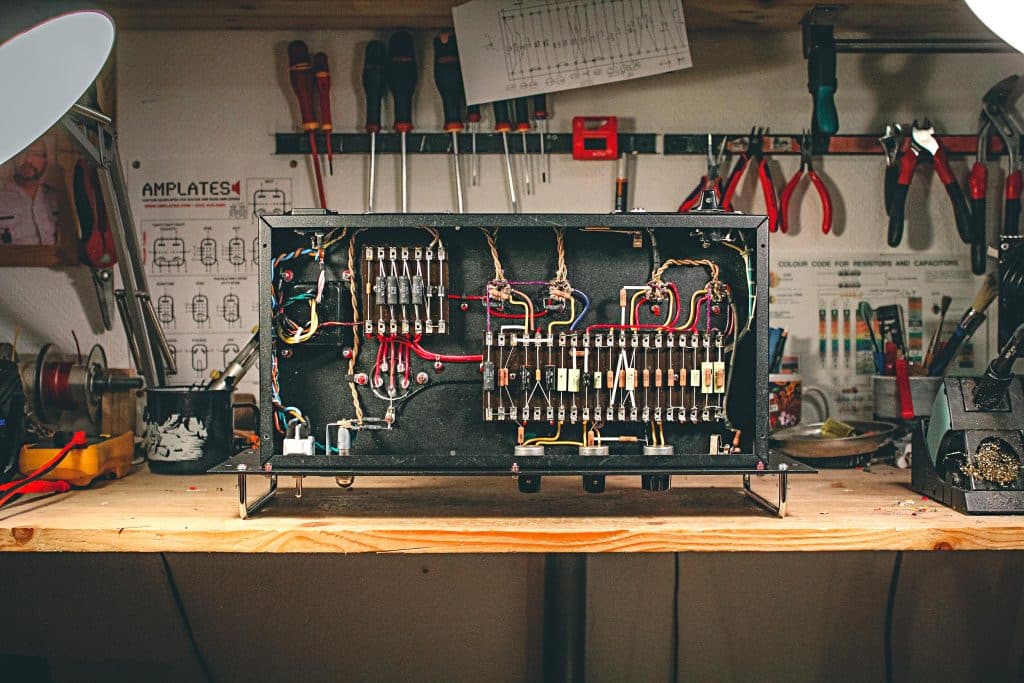
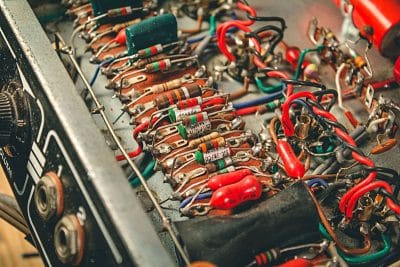
There are dozens of mounting techniques. From point-to-point assembly, which consists of the simplest possible assembly, where the components themselves are used to connect the different circuit elements to each other, to the most compact. Thanks to mounting strips or mounting supports that simplify assembly by aligning the components as much as possible on a baked board or any other insulating material equipped with pins to which the connecting components and wires can be soldered.
We end up with the famous printed circuits, the whole “through-hole” assembly: the components are installed on the circuit, their wires pass through the circuit and are then soldered directly to the tracks. Surface Mount Devices (SMD): Here, the components have shapes that allow for direct mounting on the circuit, significantly reducing the mounting surface.
The first two techniques are obviously related to the beginnings of electronics, which can be called a “paleo-electronic” era. The components are large, the chandelier circuits are simple: no one asks a question and mounts “in the air.” The advantage of this type of installation is twofold: the risk of capacitive coupling or internal heating is eliminated, allowing better access to the circuit for maintenance. Mounting on the flap board is illogical and practical: streamlining for the industry. It is much simpler to produce these circuits in series.
The printed circuit board presents itself as a solution to two problems: the miniaturization of components and thus circuits, but also the arrival of the transistor. PCB boards are easy to manufacture, avoid many tedious steps for assemblers, and are particularly resistant to shocks and movements compared to their older counterparts.
Yes, mounting a lamp or a transistor amplifier in flying wiring is indeed snobbery. But a form that can be perfectly understood. For my part, I see my work as that of a craftsman and not as that of a design firm outsourcing the work to a team of qualified writers. Wiring an amplifier or an effect pedal is a special moment for me, where you express all the acquired knowledge and where the know-how of the electronic craftsman comes into play. Each assembly is a bit and must be unique. That’s exactly what I strive for with my clients.
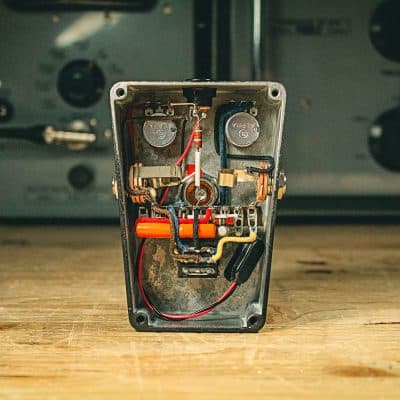
This may not play (or little, I give the benefit of the doubt to most audiophile readers) on the final sound result, but the entire circuit will be perfectly coherent and easily editable during the inevitable maintenance. Yes, this is a particularly important point: for over ten years, I have repaired and restored electronic equipment: amplifiers, magnets, effect pedals, radios.
It’s hard to measure the number of faulty peripherals passed through my desk. Whether it’s 90s style guitar amplifiers, 50s Hi-Fi amplifiers, 30s recorders, or even a cutting-edge radio, I’ve had the chance to get my hands on almost everything and have come to a very simple conclusion: printed circuits are very poorly aged and offer little reliability in terms of maintenance. This is particularly true with devices that include tubes; I have seen so many poor choices combining PCBs and tubes that I just have to close my eyes to remember the horror stories.
Conclusion
Through my work and my choice to work without PCBs, I want to perpetuate this paleo-electronic know-how. Engineers thought their devices made them easily modifiable and repairable. Not that their results often break down; quite the opposite, but simply in a spirit that seems quite logical: “You buy my equipment for a lifetime,” or even for several lifetimes, I would add. It’s hard to estimate the number of electronic devices over 50 years that still work perfectly, decades later.
Choosing a printed circuit rather than old wiring is ultimately a purely artistic and personal choice. There are superb SMD media on multilayer circuits and horrible piles of shapeless wires mounted with invaluable components that sound terrible. Mounting an agophonic material on PCBs would never come to mind, even if the idea is tempting. It’s out of nostalgia and passion that I am happy to continue working as an electronic engineer in the 1950s. It’s a bit in the spirit of the times, isn’t it? I prefer to leave devices that will always be repairable compared to waste for future generations.
Tag: engrave printed circuit without a photoresist