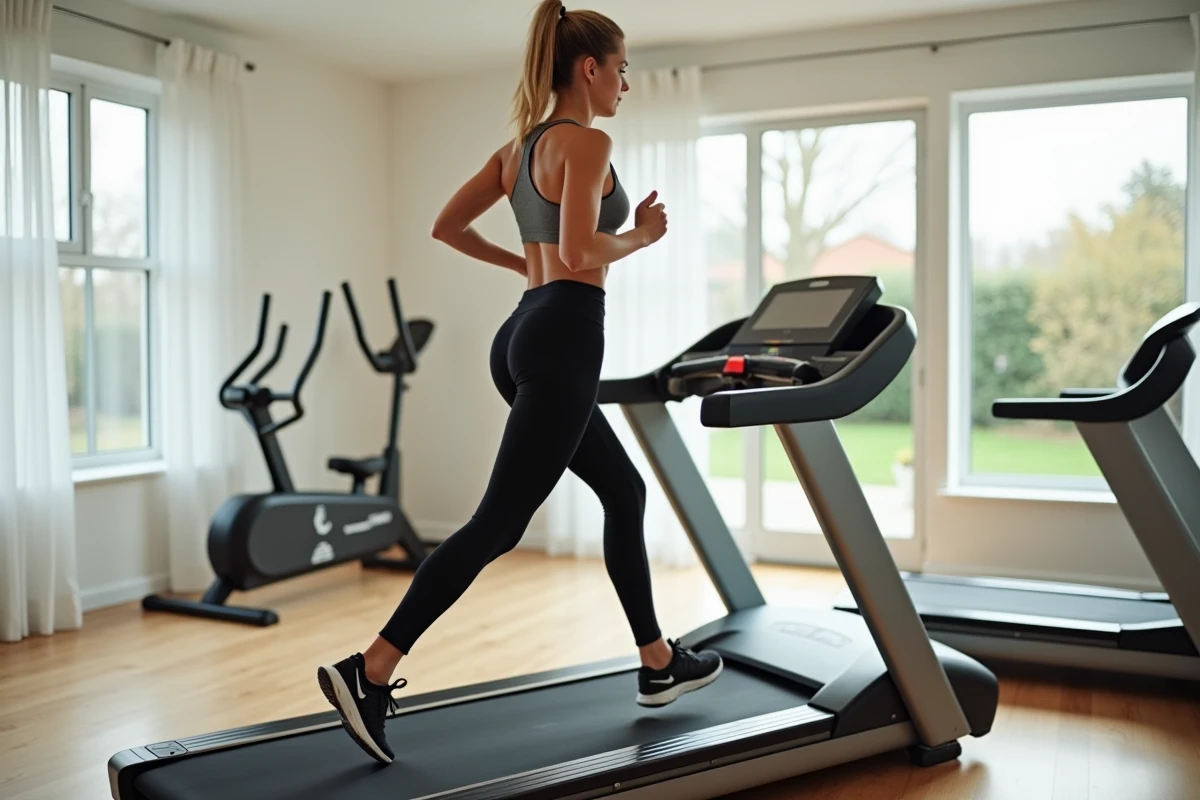
The ISE SY-1001 is powered by a DC motor with a modest nominal power, calibrated for brisk walking and light jogging. This technical positioning makes it a device suitable for daily fitness use, provided that its mechanical limits are understood and it is used in the right context.
Power Supply and Constraints of the DC Motor on the ISE SY-1001
The ISE manufacturer’s manual specifies a requirement rarely highlighted in consumer tests: a dedicated 10A outlet, separate from that used for household appliances. This technical point deserves special attention.
Entry-level DC motors, like the one in this model, are sensitive to voltage fluctuations when sharing a circuit with high-consumption devices (oven, washing machine). Sharing a circuit can cause micro-cuts that accelerate the wear of the motor’s brushes and, in some cases, generate overheating.
Since 2024, European authorities have reported an increase in incidents related to overheating of cheap DC motors on entry-level treadmills. We recommend plugging the device into a dedicated wall outlet, ideally protected by a dedicated residual current circuit breaker, rather than using a power strip.
For a detailed analysis of this device’s specifications, the ISE SY-1001 treadmill is the subject of a comprehensive test that details its technical characteristics.
Shock Absorption and EN ISO 20957-5 Standard: What the SY-1001 is Worth in 2026
The European directive 2025/RE2024 now imposes enhanced shock absorption testing for fitness equipment, referencing the EN ISO 20957-5 standard. This regulatory framework aims to reduce joint injuries related to insufficient cushioning.
The SY-1001, designed before this regulatory evolution, has not been certified according to these new criteria. Its shock absorption system remains basic compared to 2026 models that incorporate multi-layer elastomer layers or spring platforms.
In practical terms, this means that the device is suitable for regular brisk walking, but prolonged jogging sessions place more strain on the knees and ankles than a model compliant with the new standards. For daily active walking use, this shortcoming remains acceptable. For running training with repeated impact, we recommend a higher-end model.
Durability of the Running Belt in Daily Use
Field feedback, notably compiled by Que Choisir in a consumer report from April 2026, reveals a recurring friction point: the running belt degrades after six to twelve months of moderate daily training.
Lubrication is the distinguishing factor. The SY-1001 requires regular maintenance of its belt with a suitable silicone lubricant. Without this maintenance, friction between the belt and the deck increases, putting more strain on the motor and accelerating wear on both components.
Recommended Maintenance Protocol
- Apply a special silicone lubricant for treadmills every four to six weeks during daily use, lifting the belt on each side to distribute the product over the entire surface of the deck
- Check the belt tension every month: a belt that is too loose drifts laterally and wears unevenly, while a belt that is too tight strains the motor
- Clean the running surface after each session with a dry cloth to prevent the accumulation of dust and sweat under the belt
This protocol, rigorously applied, extends the lifespan of the belt well beyond the twelve months reported in negative feedback. Most premature degradations result from a lack of maintenance, not a manufacturing defect.
Speed Limit and Training Programs: For Which User Profile
The maximum speed of the SY-1001 is limited to 8 km/h. This ceiling excludes any use for moderate pace running (generally between 9 and 12 km/h) and restricts the device to brisk walking and very light jogging.
This is not a flaw; it is a design choice. A motor sized for 8 km/h consumes less, heats less, and lasts longer than a motor pushed to its limits to reach 10 or 12 km/h. For the target profile (fitness, cardio maintenance, light rehabilitation), this speed covers the majority of needs.
Integrated Programs and Console
The console displays basic data: time, distance, estimated calories, and speed. The integrated programs offer pace variations that are sufficient to structure a session of active walking or low-speed HIIT.
- Interval brisk walking: alternating phases at 5 km/h and 7.5 km/h over cycles of a few minutes remains the most effective format on this device
- Long session in fundamental endurance: maintaining a constant speed around 6 km/h for thirty to forty-five minutes is suitable for basic cardio work
- Active recovery: at 3-4 km/h, the treadmill serves as a post-training complement for a cool-down
Footprint and Folding: A Real Asset for Small Spaces
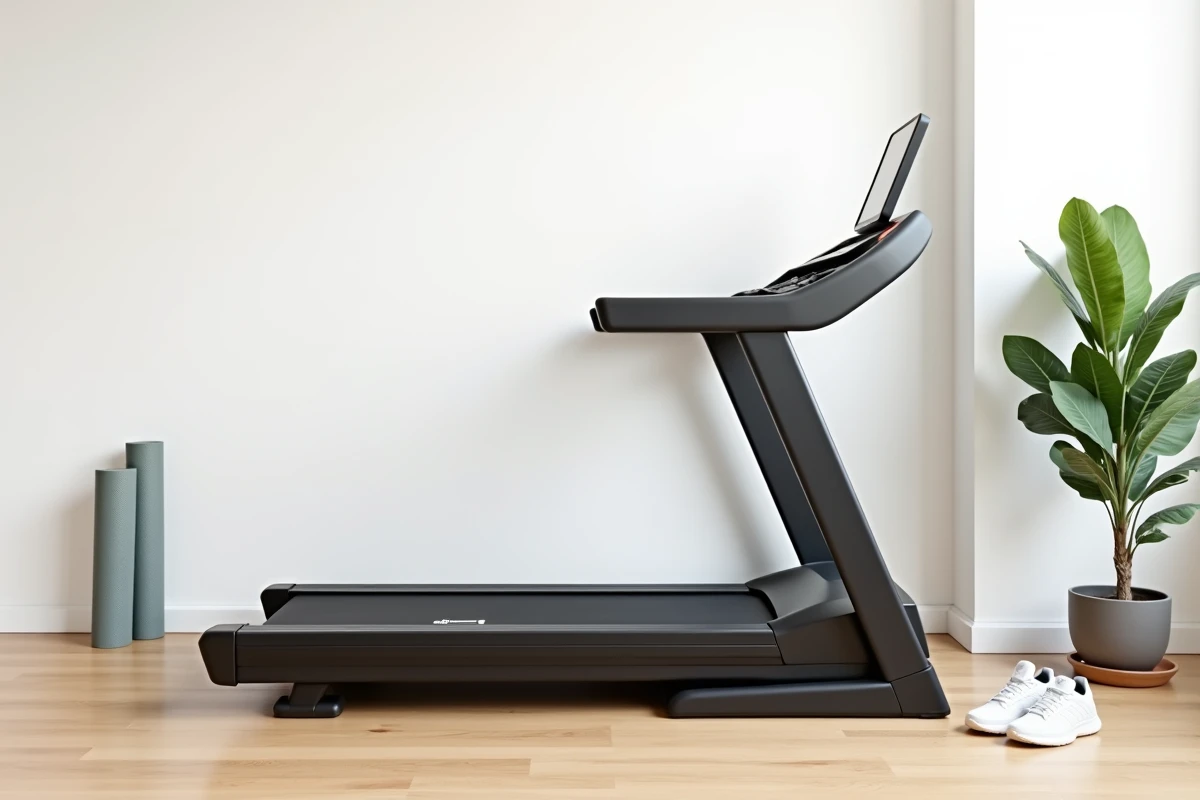
The SY-1001 folds vertically, which is its most tangible argument against the competition. Once folded, it can slide behind a door or into a closet without monopolizing floor space.
The lightweight of the device makes it easy to move, but this lightness has a trade-off: stability during use decreases as speed increases. At 7-8 km/h, we observe slight lateral vibrations on some soft floors (floating parquet, thick carpet). Placing the device on a rigid protective mat solves the problem and protects the flooring.
The foldable format and the reasonable price of the SY-1001 make it a coherent entry-level device for an apartment. Its longevity directly depends on the rigor of maintenance of the belt and adherence to electrical constraints. For use focused on daily brisk walking, it fulfills its role without excess.