
The idea that a dead louse would produce a sound perceptible to the human ear circulates on parenting forums and in some popular health articles. The head louse, Pediculus humanus capitis, measures between two and three millimeters. At this scale, the question of an audible noise upon its death or crushing deserves factual examination rather than an intuitive response.
Anatomy of the louse and sound production: what biology allows us to assert
An adult louse has a chitinous exoskeleton, a rigid covering common to insects. When a louse is crushed between the nails or with a fine comb, the breaking of this shell can indeed produce a micro-crack. This phenomenon is comparable to what is observed when pressing a sesame seed between two hard surfaces.
The nuance lies in the intensity. No published acoustic study documents an audible sound emitted by a dead louse. The entomological databases dedicated to Pediculus humanus capitis deal with morphology, life cycle, treatment resistance, but not sound signature. The available data do not allow us to conclude that a dying or recently dead louse generates a detectable noise without amplification.
A detailed article analyzes the sound of dead lice on Terre Vivante Et Santé and explores this question from a practical angle, distinguishing the mechanical crack of crushing from a hypothetical spontaneous sound.
Dead lice, empty nits: the real diagnostic confusions
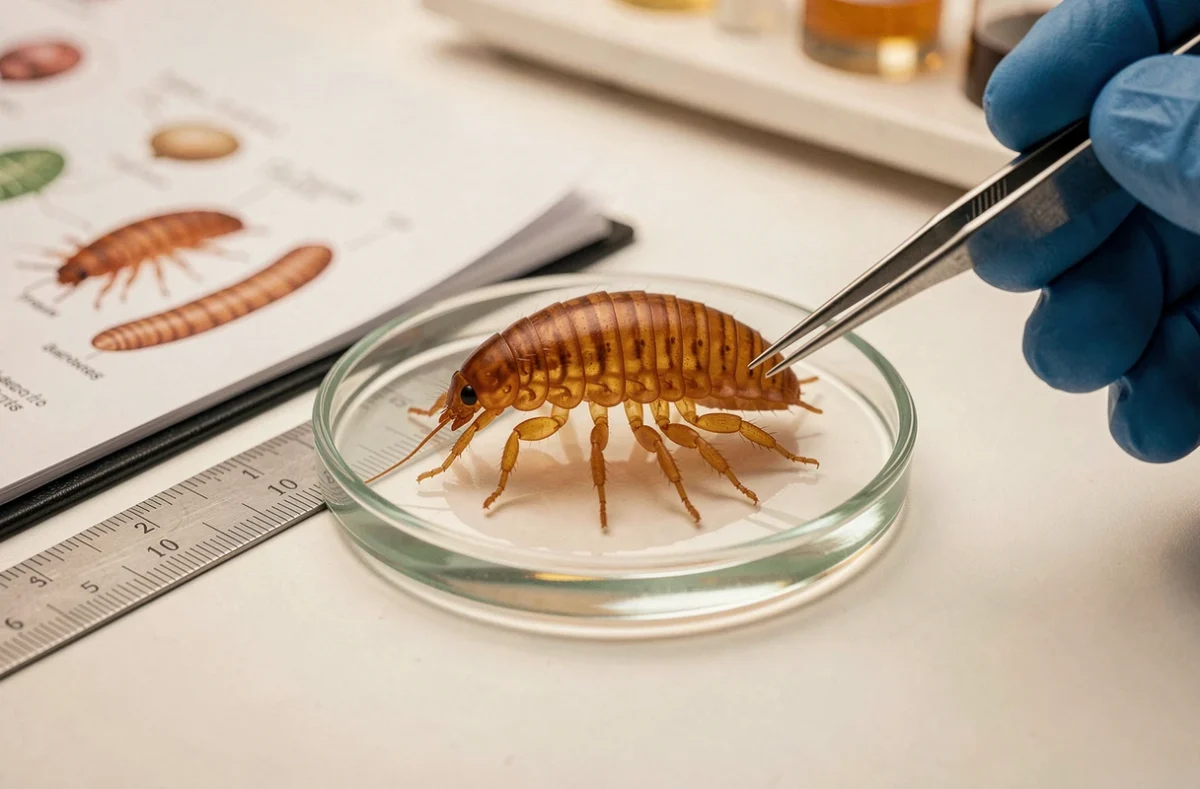
The supposed sound of a dead louse is not the only misunderstanding surrounding these parasites. The main issue reported by health professionals concerns the confusion between active infestation and old traces.
The reliable diagnostic criterion remains the observation of a living and mobile louse. Wet combing with a fine comb is presented as more reliable than visual inspection alone. A nit stuck to a hair, even several centimeters from the scalp, does not prove that an infestation is ongoing.
Empty nit shells can remain attached to hair for months after hatching. This persistence fuels false alarms: a parent spots whitish residues, assumes that lice are still present, and resumes treatment that may be unnecessary. Here are the concrete clues that distinguish an active situation from a remnant:
- A living louse moves quickly when exposed to light, making it difficult to spot without a fine comb on wet hair.
- A viable nit is generally located less than a centimeter from the scalp, brownish in color, and resists sliding along the hair.
- An empty or dead nit appears white or translucent, often distant from the root, and detaches more easily.
Relying on a sound to diagnose the death of a louse ignores these visual and tactile criteria, which are documented.
Resistance to treatments and false diagnoses: an underestimated link
The belief in a sound sign may seem innocuous. It poses a concrete problem when it leads to repeating treatments without verifying the presence of living parasites.
Resistance to conventional insecticides has become a major factor in therapeutic failure. Recent sources report documented resistance to permethrin and, in some contexts, to malathion. Applying a lice treatment based on a supposed crack, without confirming the presence of a mobile louse, exposes one to two risks: unnecessarily irritating the scalp and reinforcing the selection of resistant strains.

The reflex of systematic treatment is understandable among parents of children in communal settings. However, the approach recommended by pharmacists and pediatricians follows a precise order: wet combing, visual identification, then appropriate treatment if a living louse is found. Repeating an ineffective treatment without confirming the presence of living lice delays the correct diagnosis.
Survival outside the scalp: what lice do not do
Another myth related to sound concerns the domestic environment. Some parents describe crackling on pillows or brushes, which they attribute to dead lice. The biological reality strongly limits this hypothesis.
A head louse survives very little time outside the scalp, as it depends on body heat and frequent blood meals. Contamination from bedding or hats remains a marginal scenario compared to head-to-head contact, which is the main mode of transmission.
A crackling perceived on a pillow is therefore more likely due to another element (dry skin flakes, textile fibers, hair residue) than to an agonizing louse. Without direct observation with a fine comb, attributing a sound to a parasite is an interpretation, not a diagnosis.
The sound of dead lice: a confirmation bias rather than an entomological fact
The perception of a crack when crushing a louse between the nails is physically plausible. An exoskeleton, even tiny, offers mechanical resistance that can produce a micro-vibration. The slide into myth occurs when this momentary phenomenon becomes a diagnostic criterion.
No medical or parasitological protocol mentions sound as an indicator of a louse’s death or the effectiveness of a treatment. Field feedback varies on this point: some combing professionals report a slight noise upon crushing, while others perceive none, even on lice confirmed to be alive before handling.
This gap between individual perception and measurable reality corresponds to a classic confirmation bias. When one expects to hear a crack, the brain tends to interpret any micro-sound as the sought-after proof. The fine comb and the eye remain the only reliable tools to distinguish between active infestation and false alarm.