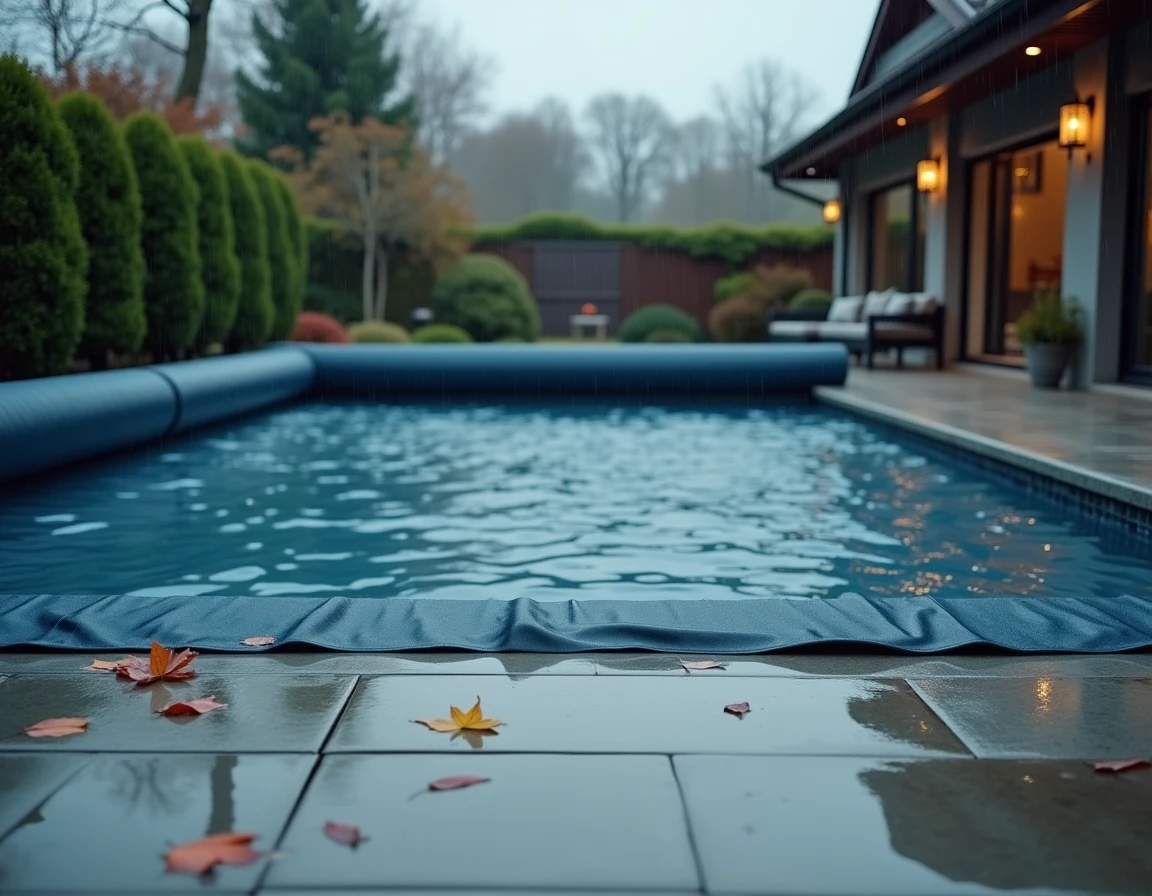
After three days of continuous rain, we discover a murky pool, a water level that flirts with the coping, and leaves stuck to the skimmer. This scenario recurs every spring and autumn in much of France. Protecting your pool from rain is not just about throwing a tarp over the basin: it involves a set of technical gestures that preserve water quality, the filtration system, and the very structure of the pool.
Stability of the pool and the supporting ground after heavy rains

Competitors almost all talk about pH and chlorine. We start from a less addressed angle: what happens under and around the pool when it rains heavily for several days.
A waterlogged soil exerts a hydrostatic pressure on the shell or the slab. For pools with shells placed on a gravel bed, this pressure can cause partial lifting of the pool if it is empty or half-filled. The reflex to remember: never completely empty a pool when a prolonged rainy episode is forecasted.
The coping and deck tiles are also vulnerable. Poorly compacted backfill around the pool absorbs water, settles, and the deck can detach or crack. The FPP has noted a significant increase in claims for ground movement after severe weather in recent years.
To learn more about Murmures Déco, the article details the reasons for covering your pool and the appropriate methods.
If you notice any settling, even slight, of the ground around the pool after a heavy rain episode, it is better to call in a professional before the problem worsens. An untreated structural disorder costs much more than an early repair.
Water level and overflow: managing excess before it becomes a problem
When rain falls continuously, the water level rises. If the pool overflows, the water carries dirt from the deck into the garden (or vice versa), and the filtration system loses efficiency because the skimmers are no longer at the correct working height.
Three reflexes to control the level
- Open the drain valve (position “sewer” on the multiport valve) as soon as the level exceeds the middle of the skimmer. We evacuate the excess to the stormwater system without touching the treated water in the basin.
- Perform a backwash of the filter immediately after the episode. This wash consumes water from the basin, which helps lower the level while cleaning the filter media loaded with rain impurities.
- Check that the overflow pipe is not blocked by leaves or debris. This point is often overlooked, and this is precisely where uncontrolled overflow begins.
The skimmer must remain at mid-water level to function properly. If the level is too high, it no longer creates surface suction. If the level is too low after excessive draining, the pump may lose prime.
Chemical balance of pool water after rain
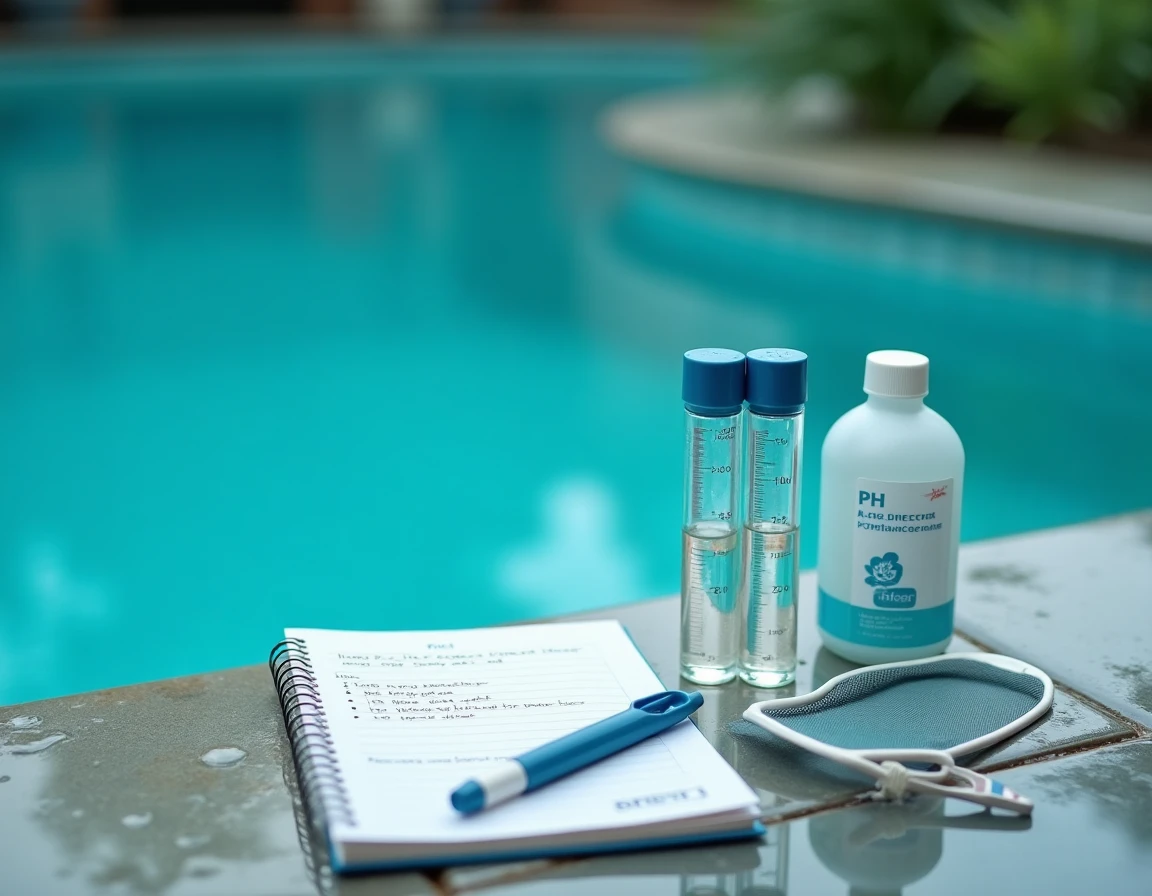
Rainwater is naturally acidic, with a pH often well below the ideal range for a chlorine-treated pool. A heavy downpour also dilutes residual chlorine and lowers the TAC (total alkalinity), which acts as a buffer to stabilize pH.
Measure before correcting
We often see owners adding shock chlorine right after the rain ends, without measuring anything. This is a mistake: if the pH has dropped very low, the added chlorine will be consumed quickly and will have almost no lasting disinfectant effect.
The sequence to follow after a rainy episode:
- Measure the TAC. If it is too low, raise the TAC before touching the pH, otherwise the pH will remain unstable.
- Adjust the pH to the appropriate range for treatment (between 7.0 and 7.4 for chlorine, between 7.4 and 7.6 for bromine).
- Check the disinfectant level and, if necessary, perform a shock treatment once the pH is stabilized.
Feedback varies on this point, but in practice, a flocculant can help clarify the water if it remains cloudy after pH correction. For sand or glass filters, a flocculant cartridge in the skimmer basket significantly speeds up the return to clear water.
Pool cover and shelter: choosing the right protection against rain
Covering the basin before the rain arrives significantly limits damage. Not all covers are equal when facing intense rainy episodes.
A bar cover or an automatic slatted cover prevents debris and some rainwater from entering the basin. It also supports the weight of accumulated water, provided it is regularly pumped out with a small cover pump. Allowing inches of water to stagnate on the tarp eventually deforms it or tears the fastenings.
A pool shelter (low, mid-height, or high) offers the most comprehensive protection. It eliminates direct contact between rain and the pool water, reduces evaporation, and maintains a more stable temperature. In return, the investment is significantly higher, and the shelter requires regular maintenance of its rails and seals.
Insurance and pool cover
Several French insurers, including Groupama and MAIF, have adjusted their “climate event” guarantees in recent years in response to the increase in claims related to severe storms and hail. Check the exclusions in your home insurance policy before the rainy season to avoid discovering too late that damage is not covered. Some policies require the presence of a certified cover device to compensate for a loss related to severe weather.
The choice between tarp, roller shutter, and shelter depends on the budget, the terrain configuration, and the frequency of rainy episodes in the region. In areas exposed to Cevennes episodes or repeated Atlantic rains, a shelter or an automatic cover represents an investment that pays off over time, both for water quality and for the longevity of the pool structure.